
Ōtagaki Rengetsu 大田垣蓮月 (1791-1875)
Hanging Scrolls with Turtle Painting and Poem
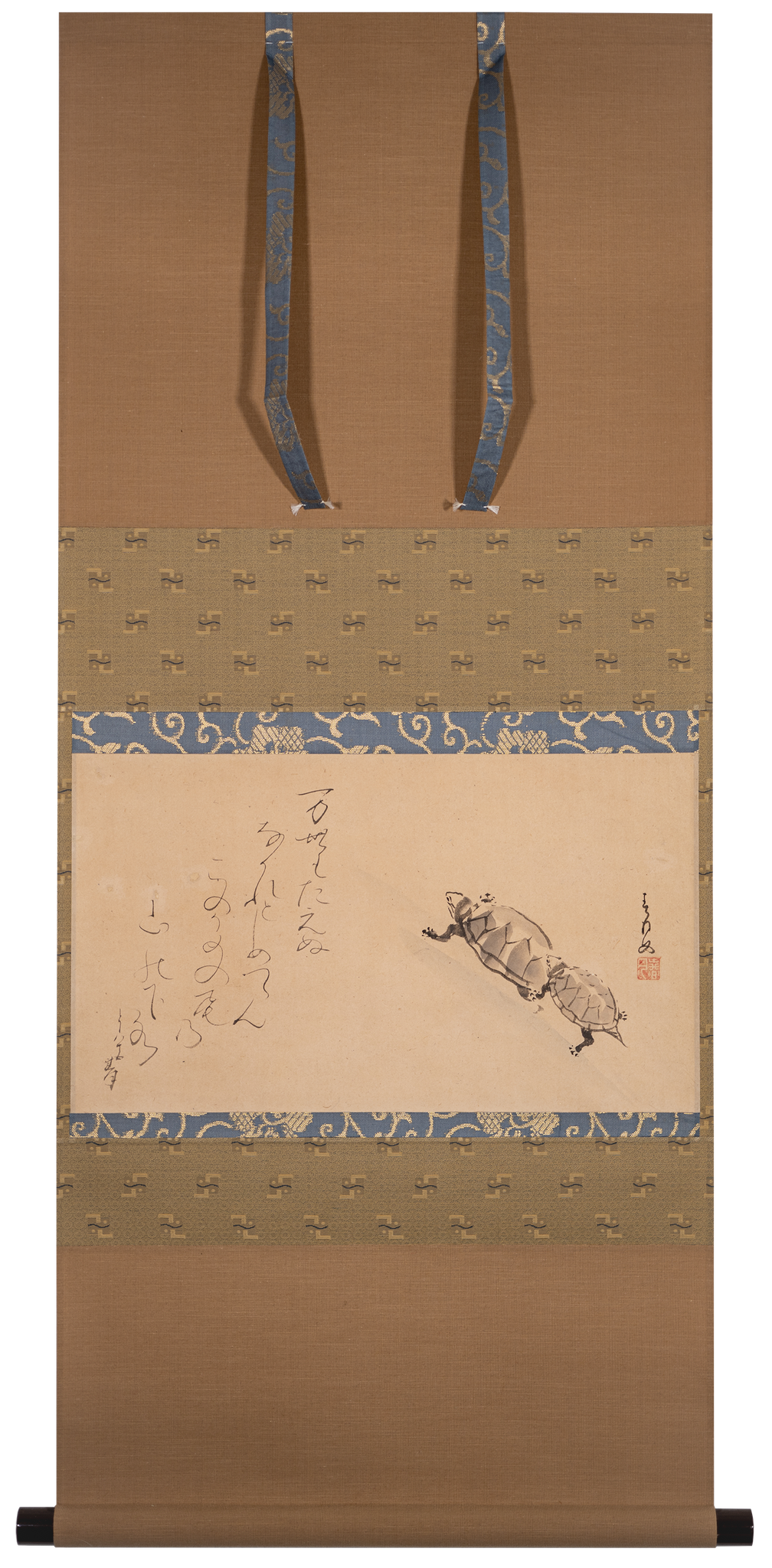


| Inv. Nr. | #23.001 |
| Date | Early Meiji period, 1875 |
| Material | Ink on paper |
| Dimensions |
H 107,0 (25,0) x W 46,0 (44,0) cm |
Comes with fitted wooden box.
Price on request
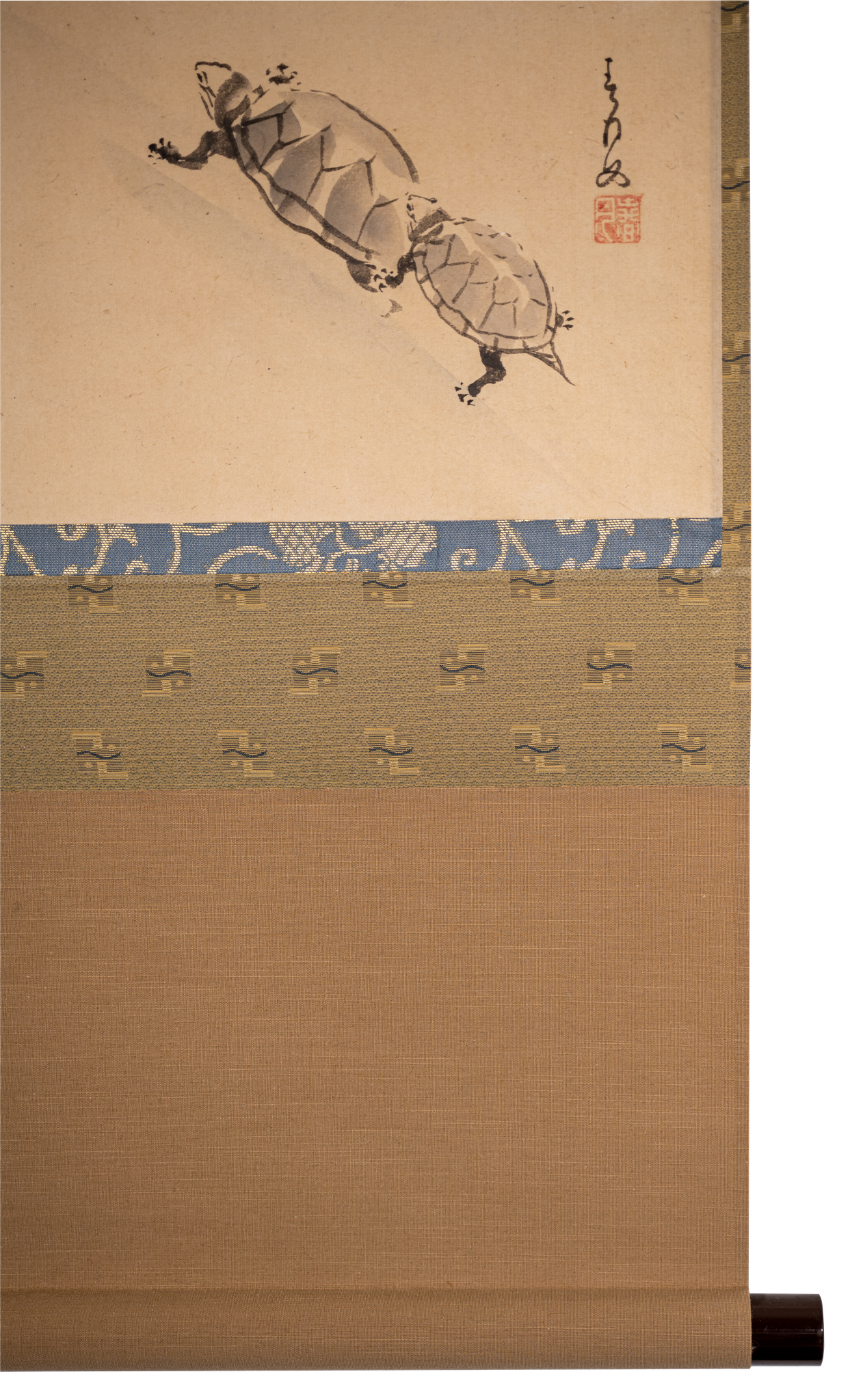
A very interesting work by Ōtagaki Rengetsu and a yet unidentified artist, showing a painting of turtles accompanied by a poem. Viewed in the Japanese manner from right to left, the turtles are arranged vertically along the right side of the composition, their heads oriented toward the beginning of the poem.
The poem reads:
For countless generations,
an unceasing flow—
so it must have been named:
the water beneath the mountain
called Turtle’s Tail.
The poem is written in four lines, the first beginning at the highest point of the composition, while each subsequent line begins slightly lower. Together with the arrangement of the turtles, this creates a subtle triangular structure that visually echoes the mountain referenced in the poem. A closer look reveals a light blue brushstroke beneath the turtles, suggesting the presence of flowing water and reinforcing the poem’s central image.
The motif of the turtle carries rich connotations in East Asian culture, where it is traditionally associated with longevity and endurance. This symbolism resonates with the poem’s evocation of an “unceasing flow” extending across “countless generations.” The reference to “Turtle’s Tail” appears to function as a poetic place name, in which natural imagery and symbolic meaning are closely intertwined.
At the same time, the poem reflects a characteristic sensibility of Rengetsu’s later work. The image of water flowing continuously beneath the mountain suggests a quiet meditation on continuity and persistence—something that endures beneath the surface of visible change. This idea carries a subtle Buddhist resonance, in which the constancy of the flow coexists with the impermanent nature of all things.
Particularly poignant is the fact that the work is signed with the artist’s age of eighty-five, the year of her death. In this context, the poem may also be read as a personal reflection on the passage of time: while individual life is finite, the underlying flow continues without interruption. The pairing of turtles and flowing water thus becomes a gentle yet profound expression of longevity, continuity, and acceptance.